
Introduction
If you've been comparing roofing options for a shed, a farmhouse, or a factory shed and keep running into the term UPVC roofing sheet, you're not alone — it's one of the most searched roofing materials right now, and for good reason.
It's lighter than metal, doesn't rust, and keeps a room noticeably cooler in peak summer. But most articles online either throw too much chemistry at you or oversimplify it to "it's just plastic roofing." Neither is very helpful when you're the one signing off on the order.
So let's actually walk through it — what UPVC roofing sheets are made of, how they're manufactured, why they hold up the way they do, and what you should check before you buy a batch. Think of this as the explanation a site engineer would give you, not a sales brochure.
What Exactly is a UPVC Roofing Sheet?
UPVC stands for Unplasticized Polyvinyl Chloride. That word "unplasticized" is doing a lot of work here — regular PVC (the kind used in flexible pipes or cheap plastic sheets) has plasticizers mixed in to make it soft and bendable. UPVC skips that step entirely, which is exactly why it stays rigid, doesn't sag in the heat, and holds its shape for years instead of months.
In simpler terms: think of a UPVC roofing sheet as a hard, weatherproof plastic panel — closer in feel to a hard hat than to a plastic bag. It's built specifically to sit on a roof, take direct sun and rain for years, and not crack, warp, or fade the way a basic plastic sheet would.
Why the "Unplasticized" Part Actually Matters
A lot of buyers assume all plastic roofing is roughly the same. It isn't. Cheaper, plasticized sheets soften under heat and become brittle in cold — which is why you sometimes see plastic roofing crack within a year or two. UPVC's rigid structure is what lets manufacturers back it with 10+ year warranties.
What's Inside a UPVC Roofing Sheet
Here's something most buyers don't realize: a decent UPVC sheet isn't one solid slab of plastic. It's actually built in layers, almost like a sandwich, and each layer has a job to do.
The Top Layer — Your Sun Shield
The outer layer is usually co-extruded with ASA or PMMA (acrylic). Picture it as sunscreen baked permanently into the sheet. This is the layer that stops the roof from turning chalky-white or yellow after two monsoons under direct sun — a problem you'll see a lot on cheaper, single-layer sheets.
The Core — Where the Strength Comes From
Underneath sits the actual PVC resin core, mixed with calcium carbonate (adds density and rigidity), impact modifiers (so it doesn't crack if something falls on it — a stray coconut, a ladder, hailstones), and heat stabilizers (so the sheet doesn't deform during the hot manufacturing process or later, on your actual roof, in peak summer).
Some manufacturers also foam this core slightly, which sounds odd but actually helps — it traps tiny air pockets that improve insulation and cut down the sheet's overall weight.
The Hidden Extras — Anti-Fungal, Anti-Corrosion Additives
For coastal areas or humid regions — think Kerala, coastal Tamil Nadu, or anywhere near a poultry farm — manufacturers add anti-fungal and anti-corrosion compounds into the mix. Without this, you'll start seeing black fungal patches on the underside within a couple of monsoons.
How These Sheets Are Actually Made
You don't need to know manufacturing to buy roofing sheets, but understanding the process helps you spot a poorly made one.
Step 1 — Mixing the Raw Material
PVC resin, calcium carbonate, stabilizers, and pigments get blended into a uniform compound. If this mixing isn't precise, you get sheets with weak spots — patches that are more brittle than the rest of the sheet.
Step 2 — Co-Extrusion
This is the real technical part. The compound is pushed through a co-extrusion machine that fuses the core and the UV-resistant top layer together in one continuous pass, under heat and pressure. This is what makes it one solid sheet instead of two layers glued together (glued layers peel apart over time — fused ones don't).
Step 3 — Giving It Shape
While the sheet is still warm, it passes through rollers that press it into the corrugated or tile-profile shape you actually see on a roof. This shape isn't just cosmetic — the ridges are what let rainwater run off instead of pooling.
Step 4 — Cooling
Controlled cooling locks the shape in permanently. Rush this step, and the sheet can warp slightly — something you'll notice later as an uneven roofline.
Step 5 — Quality Checks
Before packaging, sheets are tested for consistent thickness, impact resistance, and water absorption. This is also the step that gets skipped by low-cost manufacturers, which is usually where quality problems start.
Why UPVC Sheets Perform the Way They Do
It Keeps Rooms Cooler
The layered, sometimes foam-core structure works a bit like a thermos — it slows down heat moving from the hot outer surface to the inside of the room. That's why a shed roofed in UPVC feels noticeably cooler than one roofed in bare metal sheet, especially between noon and 4 PM.
Water Runs Off, Doesn't Pool
The corrugated profile isn't just for looks — it channels rainwater along the grooves and off the edge, and the overlapping joints between sheets stop water from seeping through the seams.
It Doesn't Fade or Turn Brittle in the Sun
That UV-resistant top layer absorbs most of the sun's damage before it reaches the core. This is the difference between a roof that still looks decent after 8 years and one that's gone patchy and faded after 2.
It's Noticeably Quieter in the Rain
Ever stood under a metal shed roof during heavy rain? It's loud. UPVC's semi-rigid, layered build absorbs a lot of that impact energy instead of transmitting it as sound — so rain sounds more like a dull patter than a drumbeat.
The Real Advantages (and Where They Matter Most)
- Doesn't rust — a genuine problem-solver for coastal properties and areas with high humidity, where GI sheets start rusting within a few years
- Light but strong — easier on the structure underneath, and easier (cheaper) to transport and install
- Cuts indoor heat — matters most for poultry sheds, factories, and any space where people or animals spend hours under the roof
- Quieter during rain — a real difference if the space below is a bedroom, office, or nursery for livestock
- Doesn't need repainting — unlike metal, which needs anti-rust coating every few years
- Handles chemical exposure well — useful in industrial units where fumes or corrosive vapors are common
- Long service life — 20 to 25 years is realistic with a decent quality sheet, properly installed
- Won't sustain a flame — UPVC is self-extinguishing, so it doesn't keep burning once the source of fire is removed
- A safer alternative to asbestos — no fiber release, no long-term health risk tied to the material itself
Where UPVC Sheets Are Commonly Used
Factories and Warehouses
Poultry and Livestock Sheds
This is actually one of the biggest use cases. Poultry farmers care a lot about indoor temperature — heat stress reduces egg production and can be fatal in extreme cases — and UPVC's insulation genuinely helps keep shed temperatures more stable.
Homes — Balconies, Porches, Sheds
For residential use, people usually pick UPVC for car porches, balcony covers, and garden sheds. Some variants even come in a tile-profile design that looks closer to a conventional roof than a typical corrugated sheet.
Commercial Canopies and Walkways
You'll see this on parking shelters and walkway canopies in malls or office complexes — spots where a clean, modern finish matters as much as function.
Myths That Need Busting
"It's basically the same as a plastic tarp or acrylic sheet."
Not even close. UPVC is a rigid, layered, engineered material — not a flexible plastic sheet. The manufacturing process alone (co-extrusion under heat and pressure) puts it in a different category.
"Plastic roofing doesn't last."
That's true for thin, low-grade plastic sheets — not for properly made UPVC. A sheet with the right UV layer and thickness will comfortably outlast the 10-15 year lifespan you'd typically expect from a GI metal sheet.
"It cracks in cold weather."
This happens with cheap, thin sheets that skip the impact modifiers in the core mix. A properly formulated UPVC sheet stays flexible enough across a wide temperature range that this isn't really a concern.
"One UPVC sheet is as good as another."
This is the one that costs buyers money. Sheet quality varies hugely based on resin grade, layer thickness, and whether the UV coating is actually present or just claimed on the packaging. Buying from a manufacturer you can verify — rather than an unnamed trader — matters more than people think.
What to Check Before You Buy
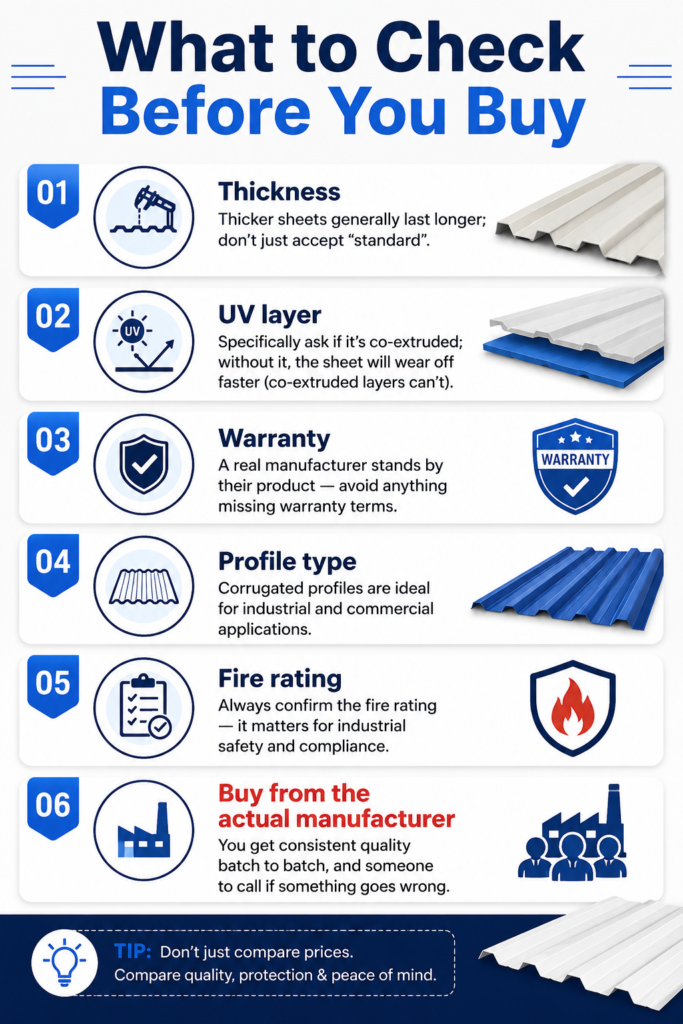
- Thickness — thicker sheets generally take more impact and last longer; ask for the exact spec, not just "standard"
- UV layer — specifically ask if it's co-extruded with ASA or PMMA, not just "UV coated" (coatings can wear off; co-extruded layers can't)
- Warranty — a manufacturer confident in their product usually offers 10+ years; be wary of vague or missing warranty terms
- Profile type — corrugated suits industrial sheds; tile-profile suits homes where appearance matters more
- Fire rating — worth confirming for industrial and commercial jobs, where fire codes may require it
- Buy from the actual manufacturer — you get consistent quality batch to batch, and someone to call if something goes wrong.
UPVC vs Metal vs Asbestos — A Quick Comparison
| Feature | UPVC Sheets | GI (Metal) Sheets | Asbestos Sheets |
|---|---|---|---|
|
Rust/Corrosion |
Doesn’t rust |
Rusts over time |
Not applicable |
|
Weight |
Light |
Moderate |
Heavy |
|
Rain Noise |
Low |
High |
Moderate |
|
Health Safety |
Safe |
Safe |
Fiber release risk |
|
Heat Insulation |
Good |
Poor |
Moderate |
|
Typical Lifespan |
20-25 years |
10-15 years |
15-20 years |
Key Takeaways
- UPVC roofing sheets are rigid, layered panels made from Unplasticized PVC with a UV-resistant outer coating• UPVC roofing sheets are rigid, layered panels made from Unplasticized PVC with a UV-resistant outer coating
- The layering — not just the raw material — is what determines how long a sheet actually lasts
- Real-world benefits: no rust, cooler indoor temperatures, quieter in rain, low maintenance
- Widely used across factories, poultry sheds, homes, and commercial canopies
- Not all UPVC sheets are equal — thickness, UV layer, and warranty are what separate a good sheet from a disappointing one
Conclusion
A UPVC roofing sheet isn't just "plastic roofing" — it's a specifically engineered, layered material designed to handle years of sun, rain, and temperature swings without rusting, fading, or cracking the way cheaper alternatives do. The catch is that quality varies a lot between manufacturers, so the actual decision comes down to checking thickness, UV protection, and warranty before you order.
If you're ready to compare options and pricing, take a look at our UPVC Roofing Sheet Price page to plan your budget, or reach out to our team at Innovative Roof Tech Pvt Ltd for a quote tailored to your project.
FAQ
What is UPVC roofing sheet made of?
It's made from Unplasticized PVC resin mixed with calcium carbonate and impact modifiers, usually topped with a UV-resistant ASA or PMMA layer for weather protection.
How long does a UPVC roofing sheet actually last?
A well-made sheet, properly installed, typically lasts 20 to 25 years.
Does a UPVC roofing sheet leak?
No, not if installed correctly. The corrugated profile channels water off the roof, and the overlapping joints between sheets keep water from seeping through.
Is UPVC roofing sheet fire-safe?
Yes — UPVC is self-extinguishing, meaning it doesn't continue burning once the fire source is removed.
Is UPVC roofing better than metal roofing?
For heat insulation, noise, and rust resistance, UPVC generally performs better. Metal can still have an edge in raw impact strength for certain heavy-duty applications.
Can I use UPVC roofing sheets for my house?
Yes — it's commonly used for balconies, car porches, and garden sheds, and tile-profile variants are available if you want a look closer to conventional roofing.
Leave feedback about this